Category: A. Garnett Weiss

  • Impromptu poem 9 (Found Poetry Review)

    Here’s the prompt for April 9 from Frank Montesonti about a novel (for Garnett) and intriguing way to approach erasure poetry and the start of a poem employing the new approach:

    “Erasure poetry in its essence….is just the idea of selection. Highlighting the words you do want to keep instead of erasing the ones you don’t ….creates new possibilities in poetic dialogue and polyvocal erasure texts….Think in terms of creating a dialogue. Highlight some phrases or words in one color, then feel if there might be a response to those words somewhere else in the text. How many voices do you hear in the text….What is the conversation…?”

    Since importing colour to this post seems impossible, after the full text, are notes to show the three voices that emerged from colour-coding on the original text, which is:

    “Nothing fills the spirit and lowers stress hormones like taking a walk in a nature preserve and connecting to the natural world, or sitting by the seashore and listening to the sound of crashing waves. We are surrounded by movement in nature, and yet, in this high-speed world, we have become disconnected with ourselves, from our ancestral ways of life, from our own sense of internal movement, and from gut rhythms. “Happy Gut”, Vincent Pedre, 2015, p. 207

    A first ‘voice’ emerged as:

    Nothing lowers nature
    listening to ourselves
    our own sense

    A second ‘voice’ emerged as:

    the spirit connecting sound
    disconnected from movement, rhythms

    A third voice emerged as:

    our ancestral ways of life

    The piece as a whole:

    Nothing lowers nature
    listening to ourselves
    our own sense

    the spirit connecting sound
    disconnected from movement, rhythms
    our ancestral ways of life


  • Impromptu poem 8 (Found Poetry Review)

    Harold Abramowitz suggested this prompt: “Write something you cannot remember: a memory of something – a story, an anecdote, a song, another poem, a recipe, an episode of a television program, anything, that you only partially or imperfectly remember. Write multiple versions, at least 6, of this memory.”

    What came to me were distinct ‘verses,’ using the syllable discipline of the tanka form and relating to the same TV broadcast, parts of which I remember, though not all of it.

    Reflections: “On the Beach”

                                                         (after Nevil Shute’s novel and subsequent films)

    Black and white flicker:
    men, women, well-dressed,
    standing on Florida sand.
    They face west, the ‘mushroom’ cloud,
    armageddon, now upon them.

    *

    Unwilling witness,
    my eleven year-old self
    watches the action;
    cannot tear myself away
    from panic or acceptance.

    *

    Services all off,
    a woman on insulin
    sees her future
    without electricity:
    A two days’ supply of life.

    *

    What happened to them,
    the characters in that play?
    I do not recall.
    It could not end well for them
    as their world, their lives collapse.

    *

    I’ve walked that shore since,
    never thinking of the outcome,
    of their hopelessness,
    but I’ve shuddered in my dreams
    at how being trapped would feel.

    *

    What I can’t forget:
    The anguish of no way out;
    scavenging, begging;
    my survival unlikely;
    desperation palpable.

  • April 7, Impromptu poem (Found Poetry Review)

    Simone Muench  suggested the following prompt: “write a cento that is a self-portrait, or anthology of your life, utilizing lines and fragments from your own work,” an intriguing and somewhat daunting task.


    You’re lost if you look, if you listen, if you follow


    Austere, without edges or colour,
    small-smiling, she looks down,

    watches, waits for a sign, any sign,

    listens for the story
    as cardinals sing a requiem among apple blossoms.
    Otherwise, she feels invisible.

    Her life lies on her lips like a mystery,
    like the ice that coats trees when you thought it would rain.

    And I begin to understand
    the legacy of those cruel shards,

    to be herself
    what will shatter with her
    in a way both welcome and not.


    Cento Gloss: Each line in this ‘self-portrait’ poem is taken unaltered from the following poems written over the past decade+: “Panorama,” “Woman of ice, woman of glass,” The April Dead II,” “Fairy Tales,” “Nero fiddled while Rome burned,” “Huis clos,” “The days of billy boy bad,” (a line from which furnished the title for the cento,) “Debut,” “Elegy for a Thrush,” “Post Partum,” “Vanishing point, “ “Where does it hurt”, “No regrets.”


  • Impromptu poem: Day 6 (Found Poetry Review)

    In response to Noah Eli Gordon’s prompt to “write a poem comprised of a single sentence, spread across at least seven lines of no fewer than 5 words each. Repeat one of your lines 3 times, but not in succession. Include the following: the phrases ‘as when the,’ a scientific term, a flower’s proper name, the name of a country in South America, a person’s proper name, the phrase ‘which is to say,’ something improper.”

    Uncle

     You make me do what I don’t want to

    but I can’t pretend I don’t understand —

    you: Self-satisfied, self-pleasured, self-absorbed, self-ish Sam—

    you speak to me in dialects I wish were foreign

    or that I’d need a cochlear implant to hear

    but I can’t pretend I don’t understand

    which is to say I’m like helianthus facing south and west

    as when the sun goes down toward Ecuador

    and I turn, too, because you make me do what I don’t want to

    but I can’t pretend I don’t understand

  • Impromptu poem: Day 5

    Here’s Garnett’s response to Sarah Blake’s prompt in the Found Poetry Review Impromptu series for National Poetry Month. She suggested choosing a song and having its dynamics open the door to a poem.  The song Garnett chose is Carole King’s “You’ve got a friend, ” which Garnett sang and read until this poem happened. Perhaps Garth Brooks will be taken by the lyrics and turn them into his next hit! LOL!

    Country, western

    So it’s a dark day, and a darker night
    And the rain’s still coming down

    You wanna put down the bottle
    but instead you take another swig

    And when I call you say you love me
    And I hesitate, oh I hesitate

    ‘Cause it’s hard to believe, so hard to believe
    after all that you’ve done, done to me

    I wanna say I love you, too, because I do
    But I hesitate, oh I hesitate

    So I ask, “is it still pourin’? Are the streetlights all on?
    Do they shine up the pavement? Ain’t they pretty”?

    You take another swig
    Then you tell me again you love me

    And I wanna say I love you, too, because I do
    Still I hesistate, oh I hesitate

    till it’s late; time to get off the phone
    watch the rain through my tears


  • April 4 Impromptu Poem through the Found Poetry Review

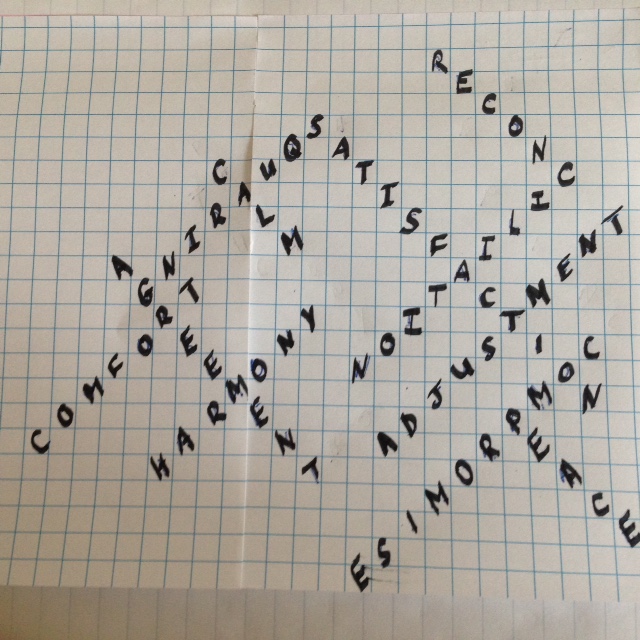
    The prompt from Woody Leslie involves meanings that have multiple words. He said “write a word, make list of other words related to it, combine these words into a woodblock sharing letters, keep rearranging, adding or subtracting words till you have a woodblock you like aesthetically both visually and linguistically… it can stand alone as a one-word poem or….)” Garnett began with one word: ‘reconciliation.’ This is what resulted.

    Afterwar

    image1

  • April 3, Impromptu Poem


    Kay lied to us. She
    couldn’t cope with such colour.
    Her vision shattered
    like stained glass, kinetic: An
    apocalypse on that day.


    Here is the prompt: “Stare at a word until the letters start to discorporate. You will find that letter cohesion, the letter glue that keeps letters stuck inside a word, is disrupted and dissolves. Fragments of letters will dislodge too. You are then free to visually interpret or document the life of letters outside their word existence as loosely or succinctly as possible.”

    While the idea was to dissociate the letters and come up with a visual interpretation/imagery that departs from the word, here’s what happened to me. Having chosen the word ‘kaleidoscope’ and having stared at it for quite a while, I found the components of the word suggested the lines above. I also tried to import a visual to add a view through the instrument as background, underneath the words, but couldn’t find a way to do that. So the short piece above appears untitled and unadorned. And I used the syllabic discipline of the tanka, BTW.

  • April 2 Impromptu ‘Lite’ Poem in Response to Found Poetry Review’s Prompt of the Day

    Drunktime is even more spectacular

    Whatever your potion
    it’s all here
    in the liquor cabinet
    packed with endless blends
    perfect proofs and an unrivalled flood
    of possibilities.
    There are so many drinks to discover
    everyday this way.


    Prompt: go to an ad, take out the nouns and add others as you will.

    Source: Ad for the Cayman Islands, The Globe and Mail, Section T, page 1, April 2, 2016

    Original text: “Paradise is even more spectacular when it’s up to 50% off. Whatever your passion, it’s all here in the Cayman Islands. Packed with endless activities, perfect beaches and an unrivalled culinary scene, there are so many reasons to discover Cayman this summer. “

  • A. Garnett Weiss to write a poem-a-day in Found Poetry Review’s April challenge

    Starting yesterday, (yes, is a day late, explanation to follow), JC, using her pseudonym A. Garnett Weiss, will follow prompts from the Found Poetry Review (FPR)  to create a poem a day during National Poetry Month.

    She intends to post them on this website at a minimum. “What can I say? I am a luddite and have as yet to figure out how to participate in this challenge on FPR’s website, except by adding the poem to my ‘what’s new’ page each day,” she sighed. “That’s why I’m a day late starting out.” She sighed again.

    “This is my first experience with writing to a regime imposed by such relentless cues. I may decide some of the ‘output’ should stay as drafts, in which case, I’ll post a ‘gap’ message, just to keep me honest.”

    Here is the first piece for April 1


    they came in May on
    the breeze; blown like tumbleweeds
    dandelions seed


    Prompts: word–tumbleweed; First 5 words–“They came in May on”

    Source: ad for Fibre Containers in Oct. 1918 monthly Magazine

  • A. Garnett Weiss: Sole Canadian poet in Silver Birch Press’s “Ides” collection of chapbooks

    The past has a habit of not only of catching up but also of having a future.

    A few years ago, JC Sulzenko began interviewing people whose choices about what to do and who to be in life interested her. In many cases, she spoke with friends and acquaintances. She also sought out strangers in lines of work she thought could offer possibilities for reflection and subject matter for her poetry.

    Her purpose: To assemble up to forty ‘portraits’ as the basis of a volume of poetry which would capture what she learned and from which she could draw out the essence of her subjects through free verse.

    She met with more than two-dozen individuals and wrote poems arising from each of these discussions. Several poems appeared in such publications as Maple Tree Literary Supplement and various volumes of The Saving Bannister.

    Then, JC admits she allowed the project to be overtaken by other events, including the production of her play and later her book for families about Alzheimer’s disease, “What My Grandma Means to Say.”

    That is until Silver Birch Press offered her the chance to have 15 pages of thematically-linked poetry included in its 2015 chapbook anthology, “Ides,” which was released on October 16, 2015.

    Published under her pseudonym, A. Garnett Weiss, “Cameos, appearances” features poems informed by the lives of a doctor, a puppeteer, a passenger train engineer, an adjudicator, a jewelry artist, a librarian, a lyricist, a friend, a teacher, a composer, an innkeeper, a chef, a volunteer and a naturalist.

    Here’s the link to the excellent video trailer Silver Birch Press produced for “Ides.”

    https://silverbirchpress.wordpress.com/2015/10/16/ides-a-collection-of-poetry-chapbooks/

    The collection is available from Amazon.com at a cost of $ 15.